Transgender adolescents on the autism spectrum, and the first clinical guidelines for care

Evidence indicates a link between transgenderism and autism spectrum disorders (ASD). John Strang, Psy.D., a neuropsychologist in the Center for Autism Spectrum Disorders at Children’s National Health System, has dedicated his career to learning more about this co-occurrence and led a group of experts who recently released the first clinical guidelines for the care of transgender adolescents with ASD.

Through a comprehensive international search procedure, the research team, led by Dr. Strang, identified 22 experts in the care of transgender youth with autism. The expert group from around the world worked together for one year to create guidelines, putting processes in place to avoid interpersonal influence or bias.

The findings, published in the Journal of Clinical Child and Adolescent Psychology, outline the first initial clinical guidelines for treating transgender adolescents with ASD.

With overall 89.6 percent consensus achieved among the identified experts, key recommendations include the importance of assessing for ASD among transgender youth, and assessing for gender concerns among youth on the autism spectrum.

More study findings and recommendations

The study also indicates that gender-related medical treatments, including cross-sex hormone therapy, are appropriate for some youth with ASD, but emphasizes the importance of providing more extended time and supports in many cases to allow an adolescent with autism to explore a range of options regarding gender.

The guidelines emphasize that for many transgender youth with autism, parents must play a more active role. “Teens on the autism spectrum often struggle understanding how others perceive them,” Dr. Strang said. “Our study found that many transgender youth on the autism spectrum require specific coaching and supports in how to achieve their gender-related needs regarding gender presentation.”

Several risks for transgender adolescents with autism were emphasized in the study, including around physical safety and obtaining employment. “Trans youth are at increased risk for bullying, persecution, and violence in the community, and those on the autism spectrum are at even higher risk, as they often struggle to read social cues and recognize potentially dangerous social situations,” Dr. Strang said.

The importance of this study

The study group did not achieve consensus around specific guidelines for when an adolescent is appropriate for commencing medical gender treatments (e.g., cross-sex hormones). A majority (about 90 percent) of the expert participants elected to identify themselves as co-authors of the study, including many well-known clinicians across the United States as well as clinicians from The Netherlands.

“Until now, care for individuals with autism and gender concerns has been a matter of individual clinician judgment. This study has allowed for dialogue and discernment between the world’s experts in this field to establish the first recommendations for care,” Dr. Strang said.

Dr. Strang is currently working on a follow-up study to more directly capture the voices and experiences of youth with this co-occurrence, as key stakeholders and collaborators in the research.
At AAP: hands-on simulation training with life-saving technology

aap_nshah_techdependentinfants_atmospheric

Recent medical breakthroughs have enabled very premature infants and children with rare genetic and neurological diseases to survive what had once been considered to be fatal conditions. This has resulted in a growing number of children with medically complex conditions whose very survival depends on ongoing use of technology to help their brains function, their lungs take in oxygen, and their bodies remain nourished.

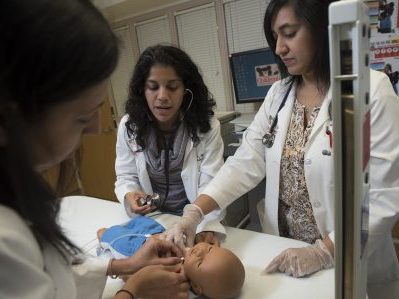
“Many pediatricians care for technology-dependent children with special health needs,” says Neha Shah, M.D., M.P.H., an associate professor of pediatrics in the Division of Hospitalist Medicine at Children’s National Health System. “These kids have unique risks – some of which may be associated with that life-saving device malfunctioning.” Because there is no standard residency training for these devices, many clinicians may feel ill-equipped to address their patients’ device-related issues. To bridge that training gap, Dr. Shah and co-presenters, Priti Bhansali, M.D., M.Ed., and Anjna Melwani, M.D., will lead hands-on simulation training during the American Academy of Pediatrics 2016 National Conference.

“Inevitably, these things happen at 3 in the morning,” Dr. Shah adds. “Individual clinicians’ skill level and comfort with the devices varies. We should all have the same core competency.”

How the training works

During the simulation, the audience is given a specific case. They have eight minutes to troubleshoot and resolve the issue, using mannequins specially fitted with devices, such as trach tubes and feeding tubes, in need of urgent attention. Depending on their actions, the mannequin may decompensate with worsened breathing and racing heartbeats. The high-stakes, hands-on demo is followed by a 12-minute debrief, a safe environment to review lessons learned. Once they complete one simulation, attendees move to the next in the series of four real-life scenarios.

“We’ve done this a few times and my heart rate still goes up,” Dr. Shah admits. After giving similar training sessions at other academic meetings, participants said that having a chance to touch and feel the devices and become familiar with them in a calm environment is a benefit.

Dr. Shah came up with the concept for the hands-on training by speaking with a small group of peers, asking about how comfortable they felt managing kids with medical complex cases. The vast majority favored additional education about common devices, such as gastronomy tubes, tracheostomy tubes, and ventriculoperitoneal shunts.  In addition to the in-person training, the team has created a web-based curriculum discussing dysautonomia, spasticity, gastroesophageal reflux disease, enteric feeding tubes, venous thromboembolism, and palliative care, which they described in an article published in the Fall 2015 edition of the Journal of Continuing Education in the Health Professions.

“Most times, clinicians know what they need to do and the steps they need to follow. They just haven’t done it themselves,” Dr. Bhansali adds. “The simulation forces people to put their hands on these devices and use them.”

AAP 2016 presentations:
Saturday, October 22, 2016

  • W1059- “Emergencies in the Technology-Dependent Child: What Every Pediatrician Should Know” 8:30 a.m. to 10 a.m. (SOLD OUT)
  • W1131-  “Emergencies in the Technology-Dependent Child: What Every Pediatrician Should Know” (Encore) 2 p.m. to 3:30PM

The benefits of deep brain stimulation for pediatric patients

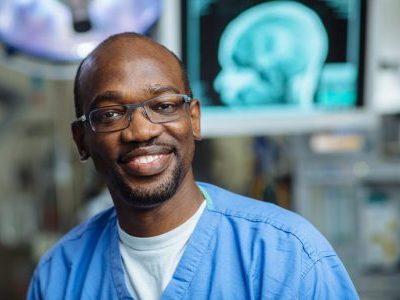
Chima Oluigbo

There was no effective treatment for uncontrolled, difficult, and sometime painful movements associated with movement disorders. That is, before the development of deep brain stimulation (DBS) techniques.

Children’s National Health System is one of only two children’s hospitals with fully integrated DBS programs. Chima Oluigbo, M.D., who leads the pioneering Deep Brain Stimulation Program within Children’s Division of Neurosurgery, is one of few pediatric deep brain stimulation experts in North America and cross-trained in pediatric and functional neurosurgery.

Dr. Oluigbo says the effects of DBS are often dramatic: 90 percent of children with primary dystonia show up to 90 percent symptom improvement.

A 6-year-old boy with dystonia so severe that his body curved like a “C” was one of the first patients to undergo the procedure at Children’s National. Six weeks later, he gained the ability to sit straight and to control his hands and legs. He also was able to smile, an improvement that brought particular joy to his parents.

Inside the brain with movement disorders

Patients with movement disorders experience difficulties due to neurological dysfunction that impact the speed, fluency, quality, and ease in which they move. In these cases, neurons in the brain’s motor circuits misfire. Through the use of DBS, neurosurgeons can synchronize neuronal firing and accomplish the previously impossible: restoring muscle control to patients with these disorders.

Movement disorders are common in children. “It’s not just numbers, it’s also about impact. Think about the potential of a child who is very intelligent and can contribute to society. When that child is not able to contribute because he or she is disabled by a movement disorder, the lost potential is very significant. It has an impact,” Dr. Oluigbo says.

What is deep brain stimulation?

DBS uses an implantable device to send continuous, low-level electrical impulses to areas deep within the brain. The impulses prevent the brain from firing abnormal signals that are linked to movement disorders and seizures. When a child is considered to be a candidate for the technique, here’s what happens next:

  1. Imaging: Magnetic resonance imaging (MRI) helps pinpoint the area of brain tissue responsible for movement disorders and informs the treatment plans.
  2. Neurotransmitter implant procedure: Using minimally invasive neurosurgery techniques, doctors access the brain through a tiny incision in the child’s skull and place thin, insulated wires (leads) in the area of brain tissue responsible for the condition.
  3. Pulse generator implant procedure: The pulse generator (neurostimulator) is a battery-operated device that sends low-level electrical impulses to the leads. During a separate procedure, the pulse generator is implanted near the child’s collarbone. Leads are threaded under the child’s skin to connect with the pulse generator.
  4. Stimulation treatments: Once the leads and pulse generator are connected, the child receives a continuous stream of electrical impulses. Impulses are generated by the neurostimulator, travel through the leads, and end up in the deep tissue of the brain. Here, they block abnormal signals that are linked to the child’s movement disorder.
  5. Follow-up care: The child will likely need deep brain stimulation throughout his or her lifetime to make sure the device is working correctly and to adjust the neurotransmitter settings to meet his or her changing needs.

Deep brain stimulation at Children’s National

Children’s National is currently conducting clinical trials seeking to expand the use of this procedure to patients with cerebral palsy, one of the most common dystonias. The effective use of deep brain stimulation requires ongoing attention from a multidisciplinary team (from neuropsychology to rehabilitation medicine), giving seamless care under one roof.

There is evidence to suggest that this technique could be used to aid people with memory disorders, patients in minimally conscious states, and patients with incurable epilepsies.

New brain tumor research collaborative taps Children’s for scientific director

Dr. Roger Packer

This year, more than 4,600 children and adolescents (0-19 years) will be diagnosed with a pediatric brain tumor. Brain tumors have now passed leukemia as the leading cause of pediatric cancer-related deaths. Despite this, there has never been a drug developed specifically to treat pediatric brain tumors and for many pediatric brain tumor-types, no standards of care or effective treatment options exist. In particular, pediatric high-grade gliomas have no standard of care and a very low survival rate.

To combat this, the National Brain Tumor Society (NBTS), the largest nonprofit dedicated to the brain tumor community in the United States, with its partner, the St. Baldrick’s Foundation, the largest private funder of childhood cancer research grants, as well as several world-renowned experts in the field of pediatric neuro-oncology, announced a new awareness and fundraising campaign to support a major translational research and drug discovery program. The campaign, called “Project Impact: A Campaign to Defeat Pediatric Brain Tumors,” was unveiled at the National Press Club in Washington, DC, on Sept. 12. Watch the live streaming replay.

Children’s National brain tumor expert leads the way
The collaborative hopes to improve clinical outcomes for pediatric brain tumor patients and inform the development of the first standard of care for treating pediatric high-grade gliomas, including DIPG – the deadliest of pediatric cancers.

Roger J. Packer, M.D., Senior Vice President of the Center for Neuroscience and Behavioral Medicine and Director of Brain Tumor Institute at Children’s National Health System, serves as the Scientific Director of the Defeat Pediatric Brain Tumors Research Collaborative.

“Treatment of pediatric high-grade gliomas has been extremely frustrating with little progress made over the past quarter century,” said Dr. Packer. “New molecular insights provide hope that therapies will be dramatically more effective in the very near future. In the last two years alone we have had great breakthroughs, primarily identifying genes which are critical in development of new pediatric treatments. But we need to maintain forward momentum from discovering the molecular and genetic underpinnings of these tumors, to understanding how these changes drive these tumors, and to ultimately developing effective, biologically precise therapies. This is a major opportunity for the field, patients, and their families.”

Pediatric high-grade gliomas make up to 20 percent of all pediatric brain tumors with roughly 500-1,000 new diagnoses every year. These tumors are WHO Grade III and Grade IV gliomas, including: pediatric glioblastoma (GMB); glioma malignant, NOS; pediatric anaplastic astrocytoma; anaplastic oilgodendroglioma; giant cell glioblastoma; gliosarcoma; and diffuse intrinsic pontine gliomas (DIPG).

David Arons, CEO of the National Brain Tumor Society said, “Researching and developing new treatments for pediatric brain tumors is a particularly challenging task, which faces multiple – but interrelated – barriers that span the research and development spectrum from small patient populations, lack of effective preclinical models, to complex basic biology, regulatory hurdles and economic disincentives. To overcome these complex challenges, and get better treatments to patients, we needed to create an equally sophisticated intervention. We believe that having groups with complementary skills work together in a coordinated effort, sharing data and expertise, and tackling the problem from multiple angles as one team is the starting point for greater and faster progress.”

How the collaborative is set up
The model for the collaborative consists of scientists and researchers who will each lead interrelated “Cores” to work on critical areas of research simultaneously and in concert with one another, encouraging sharing of findings real time. This design allows new findings to quickly move onto the next stage of research without barriers or other typical delays, significantly speeding up the research process.

Dr. Packer said the goal of this research collaboration is to work with pediatric brain tumor researchers from around the world to discover new treatments for children in the next two to three years, instead of the next decade.