Rethinking pediatric cancer treatment: Q&A with Elena Vasileva, PhD

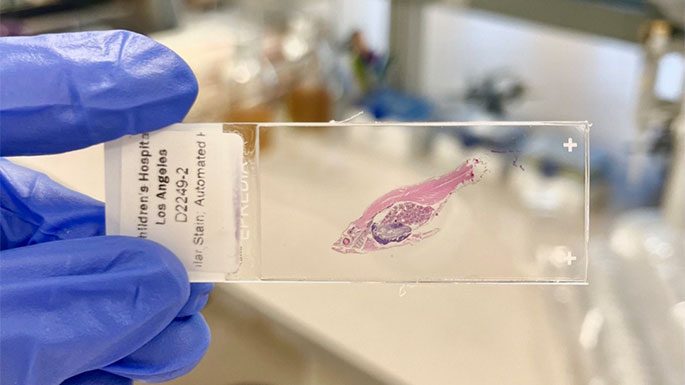
Using advanced zebrafish genetic models, Dr. Vasileva can track cancer cells as they grow and spread within living organisms, offering an unprecedented view into tumor development.
What if researchers could watch pediatric cancers develop in real time and uncover the earliest moments when healthy cells become tumors? That question drives Elena Vasileva, PhD, a principal investigator at Children’s National Research Institute, whose work explores how childhood cancers begin, evolve and interact with the cells around them.
Using advanced zebrafish genetic models, Dr. Vasileva can track cancer cells as they grow and spread within living organisms, offering an unprecedented view into tumor development. Her research combines molecular oncology, developmental biology and emerging technologies such as single-cell analysis to better understand the vulnerabilities of pediatric cancers and identify new opportunities for treatment.
As she builds her laboratory at Children’s National with the support from the Center of Cancer and Immunology Research and Brain Tumor Institute, Dr. Vasileva is focused on advancing precision pediatric oncology and developing new research models for childhood cancers that remain understudied. Here, she shares what drew her to Children’s National, the promise of zebrafish models and the future of pediatric cancer research.
Q: What brought you to Children’s National?
A: I was looking for a highly collaborative environment where scientists and clinicians work closely together to solve important problems. Children’s National stood out because of its strong pediatric oncology program and translational focus. I was excited by the opportunity to work alongside leaders in the field like Drs. Catherine Bollard, Roger Packer and Muller Fabbri, and contribute to research that can ultimately improve care for children.
Q: What is the focus of your research program?
A: My research sits at the intersection of molecular oncology and developmental biology. I’m interested in understanding how pediatric tumors initiate, develop and progress, as well as how they interact with the surrounding cellular environment. By uncovering the molecular mechanisms that drive these processes, we hope to identify new therapeutic opportunities.
Q: How do zebrafish models help advance pediatric cancer research?
A: Zebrafish allow us to introduce mutations found in human pediatric cancers and observe tumor development in real time. Because the animals are transparent during development, we can visualize how cancer cells grow, spread and interact with other cells. Importantly, childhood cancers arise in growing organisms, so zebrafish provide a dynamic developmental context that closely aligns with the biology we are trying to understand.
Zebrafish provide a dynamic developmental context that closely aligns with the biology researchers are trying to understand.
Q: What advances in the field are you most excited about?
A: Technologies such as single-cell transcriptomics, proteomics, spatial biology and computational analysis are transforming how we study tumors. We can now examine individual cells within a tumor and better understand why some respond to treatment while others do not. These tools are helping drive a shift toward precision pediatric oncology and more personalized therapies.
Q: What role could artificial intelligence play in cancer research?
A: Artificial intelligence has tremendous potential to help researchers analyze tumor architecture and cellular morphology more efficiently. It can distinguish different cell types and detect subtle changes very quickly, which could help us better understand tumor heterogeneity and identify new biological insights.
Q: What challenges remain in pediatric oncology?
A: Pediatric cancers remain significantly underfunded, and many rare childhood cancers still lack strong research models. Because pediatric cancers are biologically different from adult cancers, discoveries in adult oncology cannot always be applied to children. Continued collaboration, awareness and investment are essential to advancing research and developing better treatments.
Q: What are your goals for the future?
A: I hope to build a robust research program that develops new zebrafish models for pediatric cancers, particularly those that currently lack effective experimental systems. My long-term goal is to bridge fundamental biological discovery with translational impact by identifying tumor vulnerabilities and testing new therapeutic strategies that can benefit patients.