Children’s National and Virginia Tech deepen pediatric AI collaboration to accelerate innovation for children
Experts from academia, clinical care, industry and government recently gathered to explore how artificial intelligence (AI) is rapidly reshaping pediatric health, from early-stage scientific discovery to real-world clinical care.
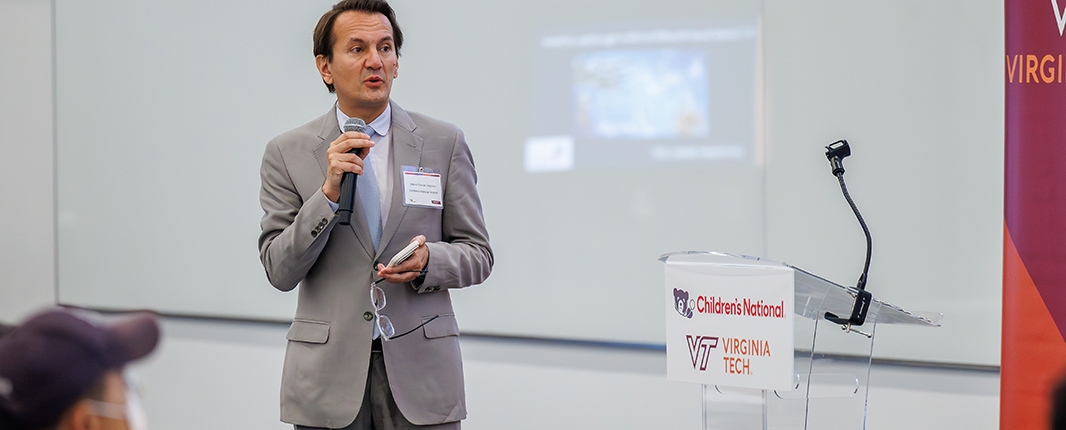
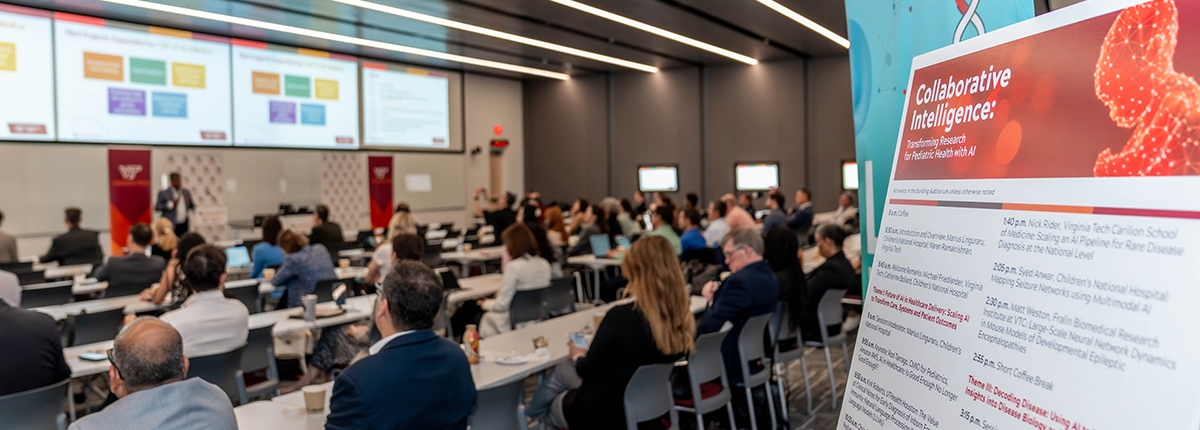
Hosted by Children’s National Hospital and Virginia Tech, the third annual AI for Pediatric Health Symposium highlighted the growing momentum behind the Pediatric Health AI Innovation Hub, a collaborative initiative designed to bring together clinicians, researchers, engineers and data scientists to accelerate AI-driven innovation focused specifically on children.
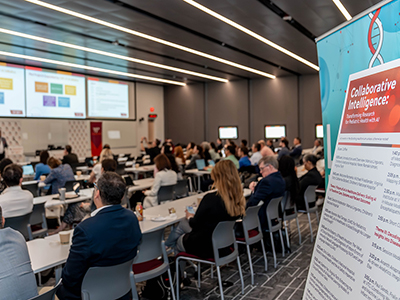
Held at Virginia Tech’s Academic Building One in Alexandria, Virginia, the symposium showcased how Children’s National and Virginia Tech are helping lead the national conversation around the future of pediatric AI and the importance of developing technologies designed specifically for children, not simply adapted from adult medicine.
“Children’s health presents some of the most important and complex opportunities for artificial intelligence,” said Catherine Bollard, MBChB, MD, chief research officer at Children’s National. “But meaningful progress only happens when AI development is grounded in real clinical environments and driven by the needs of patients, families and care teams. That is what makes this collaboration so important.”
Over the last three years, the partnership between Children’s National and Virginia Tech has evolved into a broad effort to build infrastructure, research pipelines and translational pathways capable of moving pediatric AI innovation from concept to clinical impact.
Building on that momentum, symposium organizers announced the launch and continued support of the Children’s National & Virginia Tech Pediatric Health AI Innovation Hub.
“Children have historically been underrepresented in AI research despite having fundamentally different physiology, disease patterns and developmental needs,” said Marius George Linguraru, DPhil, MA, principal investigator in the Sheikh Zayed Institute for Pediatric Surgical Innovation and director of the division of AI Research at Children’s National. “We have an opportunity to build pediatric AI the right way from the beginning by developing and validating these technologies specifically for children and within pediatric clinical settings.”
Organizers said that advancing pediatric AI will require close collaboration between pediatric clinicians, biomedical researchers and AI experts across institutions.
“Pediatric health presents some of the most complex challenges for artificial intelligence, from limited data to rapidly changing biology,” said Naren Ramakrishnan, PhD, University Distinguished Professor at Virginia Tech and director of the university’s Sanghani Center for Artificial Intelligence and Data Analytics. “Over the past two iterations of this symposium, we’ve seen successful partnerships emerge between Children’s Hospital and Virginia Tech, and we hope to build on that momentum by creating even more collaborations and relationships moving forward.”
For Children’s National leaders, the symposium represented more than an annual gathering. It reflected Children’s National Hospital’s position as a leading hub for pediatric AI innovation and translational research. “Artificial intelligence will play a major role in the future of pediatric medicine,” Bollard said. “Our responsibility is to ensure these technologies are developed thoughtfully, ethically and in ways that ultimately improve the lives of children and families.”
Speakers highlighted how advances in data infrastructure, machine learning and clinical integration are beginning to translate into practical applications.
“AI has a role in the delivery of pediatric healthcare and across the entire ecosystem, from basic discovery science to translation to clinical implementation,” said Michael Friedlander, PhD, executive director of the Fralin Biomedical Research Institute at VTC and Virginia Tech vice president for health sciences and technology. “We need to embrace AI at all levels, from our basic scientists to our translational researchers to our clinical healthcare providers. Our institutions will continue to make major commitments to move this work forward.”
“We are on the precipice of an extraordinarily exciting time in pediatric healthcare, discovery, translation and implementation,” Friedlander said.
The keynote address at the symposium was from Rod Tarrago, MD, chief medical information officer for pediatrics at Amazon Web Services, who explored how AI and advanced technologies could support the “quadruple aim” in healthcare by improving patient outcomes and patient experiences, reducing costs and supporting clinician well-being.
Erika Kim, PhD,Resilient Systems Program Manager for Advanced Research Projects Agency – Health introduced the agency’s Pediatric Care eXpansion program and how to scale data and knowledge networks across the United States. Other invited speakers included Kirk Roberts, PhD, from the University of Texas Health Center and Ananth Annapragada, PhD, of the Baylor College of Medicine, Texas, who spoke about natural language processing in clinical notes and AI automation, respectively.
Sally Allain, MBA, MS, Virginia Tech’s chief health sciences growth and innovation officer, moderated the second session, which focused on AI technologies and systems powering biomedical discovery and clinical applications. Sarah Clinton, PhD, Virginia Tech’s health sciences associate vice president for planning and strategy, moderated the third session, highlighting how AI is helping researchers uncover new insights into disease biology and risk. Speakers emphasized that while enthusiasm around AI continues to grow, successful implementation in pediatric healthcare depends on ensuring tools are reliable, safe and thoughtfully integrated into clinical workflows. Researchers from Children’s National discussed approaches to evaluating AI tools designed for pediatric mental health settings, while collaborators from Virginia Tech examined how machine learning systems respond as patient conditions worsen.
The symposium reflected the expanding national ecosystem surrounding pediatric AI research, with participation from industry leaders, federal agencies and academic institutions. Children’s National Hospital and Virginia Tech are leading the way in exploring how Al is advancing pediatric health – from research and data to bedside care – while fostering collaboration and innovation to improve outcomes for children.