Building the future of pediatric preparedness: Inside SPARK Capstone 2025
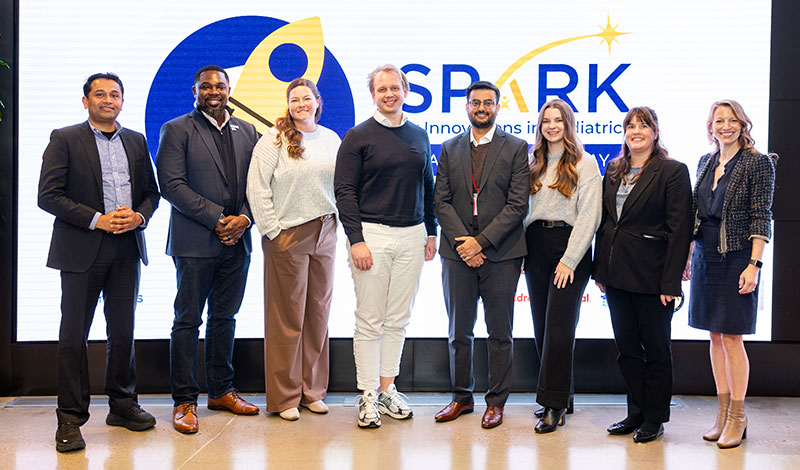
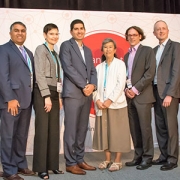
Founders from the 2025 SPARK cohort take the stage at Capstone and Pitch Day at Children’s National, presenting pediatric-first solutions to national preparedness challenges.
On November 18, the SPARK Hub for Innovations in Pediatrics welcomed federal partners, researchers, clinicians and startup founders to the 2025 Capstone and Pitch Day at the Children’s National Research & Innovation Campus. The event highlighted how pediatric-first innovation strengthens national preparedness and demonstrated the power of coordinated partnerships across the Biomedical Advanced Research and Development Authority (BARDA), the Pediatric Pandemic Network, Children’s National Hospital and the broader venture community.
From diagnostics and vaccines to emergency medicine and clinical devices, this year’s cohort elevated solutions designed to meet children where current systems fall short.
The big picture
The afternoon opened with welcoming remarks from SPARK Principal Investigator Julia Finkel, MD, followed by an overview from BARDA Program Manager Mary Larkin on how federal innovation pathways can accelerate pediatric-focused medical countermeasures.
Her remarks framed the accelerator as part of a larger national strategy: flexible public-private partnerships, non-dilutive funding models and rapid technology development cycles aimed at improving preparedness for infectious disease threats, chemical and radiological hazards and emerging public health emergencies. These same themes carried through the pitches that followed, underscoring how innovation must be timely, evidence-driven and scalable.
Why it matters
A major focal point of the afternoon was the panel discussion, “Ensuring Pediatric Equity in Medical Countermeasures: From Evidence to Action,” featuring BARDA Clinical Development Director Bill Kapogiannis, MD, and Children’s National Chief of Emergency Medicine Joelle Simpson, MD.
The conversation centered on a recurring challenge: children remain underrepresented across the entire lifecycle, including preclinical testing, adaptive trial design, regulatory pathways and distribution strategies. Because children experience distinct physiologic, developmental and social factors during emergencies, any gaps in preparedness amplify disparities.
Panelists emphasized:
- The need for earlier inclusion of pediatric data in national biodefense strategies
- System-level reforms to ensure equitable access to countermeasures
- Stronger partnerships between hospitals, federal agencies and community organizations
- Lessons from COVID that still have not been fully institutionalized, particularly around surge capacity and supply chain resilience
Their perspective shaped the lens through which the SPARK pitches were viewed: Not simply as emerging technologies, but as essential tools for equity.
Portfolio highlights
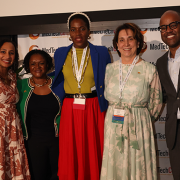
SPARK Capstone and Pitch Day 2025 signage greets partners, founders and clinicians as they gather to advance pediatric preparedness.
The 2025 SPARK cohort tackled some of the most persistent and high-stakes gaps in pediatric preparedness and care.
- AcQumen Medical: A noninvasive hemodynamic monitoring platform that supports earlier detection of circulatory collapse, sepsis and shock in pediatric intensive care units. By combining ultrasound and impedance technologies, the UltraTrac device delivers accurate, continuous measurements without invasive lines.
- BugSee: A rapid, same-day diagnostic approach for pediatric sepsis that bypasses slow culture-based workflows. Their selective lysis technology preserves viable bacteria from whole blood, enabling species ID and antibiotic susceptibility testing within hours.
- Congruence Medical Solutions: A dose-metered delivery platform that allows pegfilgrastim to be safely administered to children at precise microliter quantities. Although the drug is approved for pediatric use, current adult-focused devices prevent accurate dosing.
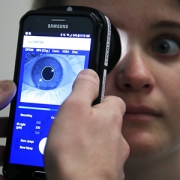
- Deep Breathe: A universal lung assessment tool designed for both children and adults, supporting earlier triage, telehealth use cases and improved respiratory decision-making across care settings.
- Rhinomed: A pediatric-specific nasal swab that significantly reduces testing-related distress, increasing parental willingness to test children for respiratory infections. Its design integrates with existing antigen and PCR platforms and improves comfort without sacrificing accuracy.
- VaxSyna: A next-generation, antibody-based vaccine platform with multi-antigen display and no adjuvant requirement. Their lead indication targets herpes simplex virus, aiming to address a condition with major neonatal morbidity and no approved vaccine.
- WearableDose: A real-time absorbed radiation dosimeter delivered as a skin patch. It provides precise, patient-specific measurements, addressing a long-standing gap in pediatric imaging and radiation safety.
- Vesynta: A pediatrics-first precision dosing digital marketplace that provides clinicians with personalized treatment insights to optimize therapeutic safety and efficacy.
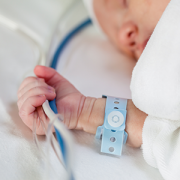
- Sibel Health: An advanced wearable sensor-based platform for remote pediatric patient monitoring in the context of pandemic response.
What’s next
Following the pitch session, a Fireside Chat session brought together SPARK founders and BioHealth Innovation mentors to explore what comes after the accelerator. They discussed regulatory strategy, commercialization planning and the translational challenges unique to pediatric-focused technologies.
Looking ahead, the SPARK program will continue to guide each company through clinical validation, FDA pathways, BARDA engagement and partnership development. Many are pursuing active or future pilots with Children’s National, strengthening a pipeline of solutions that are grounded in real patient needs and real-world clinical environments.
More broadly, the 2025 cohort reinforces a central theme: Pediatric innovation is essential to national health security. When children are fully integrated into preparedness strategies, the entire healthcare system becomes more resilient, equitable and future-ready.